


If I don't remember wrongly, Jabatan Perkhidmatan Awam (JPA) has previously denied such "formal" quotas being in existence. However, with the recent release of statistics by Datuk Dr Abdullah Mat Zin, Minister in the Prime Minister's Department in Parliament a few days ago, and published in Sin Chew Jit Poh, it has become crystal clear that there exists a specific quota on bumiputera and non-bumiputera receipients of JPA scholarships.
As the table below clearly shows, JPA has made it a specific point to award 80% of overseas scholarships to bumiputera students and the balance 20% to non-bumiputera students every years since 2000. Nothing was disclosed prior to that year.
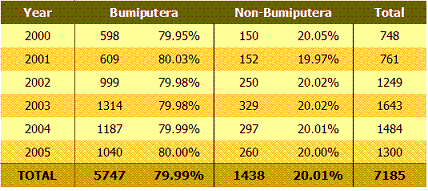
In addition, for local undergraduate scholarships, JPA has clearly allocated 30% to non-bumiputeras, and the balance 70% reserved for bumiputeras. This is shown in the table below.
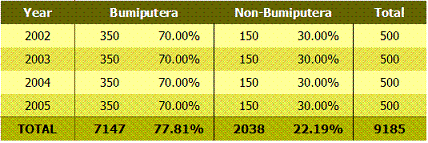
The question then is, is this a just and equitable distribution of scholarships to young Malaysians?
Personally, I'm a firm believer of affirmative action, even racially based ones under certain circumstances. However, to have between 70-80% of scholarship awards reserved for a particular ethnic group which constitutes approximately 65.9% of the population is to me grossly unjust. The scholarship distribution ratio in this situation appears to be a case of tyranny by the ethnic majority under the guise of ethnic-based affirmative action.
To me, an effective ethnic-based affirmative action policy must be balanced between providing a policy advantage to the disadvantaged group, while at the same time provide elements of incentives. That way, receipients of affirmative action policies will continue to have strong incentives to pursue excellence.
However, in our current case, it appears that the policy advantage provided is so overwhelming that the incentives for excellence are substantially (if not totally) diluted. The gap of standards between the bottom 5% bumiputeras and the bottom 5% non-bumiputeras receipients of the scholarships will be so huge, such that the long term objectives of the affirmative action policies are defeated.
Assistance must be given to bumiputeras, who with certain additional policy assistance as well as hardwork and dedication, are able to make the cut. However, such "additional assistance", if provided to under-achievers of whatever ethnic group, will just be a simple case of flushing limited and valuable public funds down the toilet bowl.
Lest my opinions be construed as seeking to eliminate the quotas altogether, I shall propose here, an alternative ethnic-based affirmative action steps and policy.
- Scholarship awards should be evaluated totally based on merit, without first taking into consideration ethnic groups. Currently, it appears quite obvious that the number of scholarships to be awarded to bumiputeras and non-bumiputeras are decided up front, and candidates of the respective ethnic groups are evaluated within the groups to fill the available pre-determined slots.
- There should however, be a minimum, say 30%, of scholarships to be awarded to Bumiputera students. I use 30% as a convenient figure, because that's the minimum wealth distribution model which our National Economic Policy is seeking to achieve in the 9th Malaysian Plan (and the ones before that).
- In the event that the evaluation based on (1) above, produces only say 25% of the proposed scholarship holders comprising of bumiputeras, then the next 5% of bumiputeras shall be offered scholarships.
- However, in the event that the evaluation based on (1) above results in 50% of the scholars being bumiputeras, then there will be no necessity for the affirmative action policies to kick in.
Such a system will be beneficial to all ethnic groups for several reasons.
- The system will provide a sense of justice to Malaysians of all races for the scholarships are not awarded to fill availability pre-alloted to particular ethnic groups, irrespective of changes in social circumstances.
- In the event that a particular ethnic group performs too poorly, it makes equitable sense for the ethnic group to be given additional policy assistance. Bumiputeras will hence be "protected" in that perspective, and yet at the same time, the advantage does not significantly eliminate the incentives necessary to pursue academic excellence.
- However, in the event whereby the "disadvantaged" ethnic group has clearly advanced its well-being and demonstrated an ability to compete on equal footing, the affirmative action policy is automatically made obsolete without a necessity of having to make subjective judgements of "readiness" to compete. For instance, once a merit-based evaluation produced 50% bumiputera scholars, then the 30% quota is automatically made obsolete. The crutches, which are often difficult to discard, can hence be transparently and justifiably removed without even a need to revise government policy.
- A just and trustworthy government;
- Free and liberated people;
- A rigorous pursuit and mastery of knowledge;
- Balanced and comprehensive economic development;
- A good quality of life for the people;
- Protection of the rights of minority groups and women;
- Cultural and moral integrity;
Footnote: While I feel very strongly with regards to the above topic, I actually had to think twice about publishing this blog post on this thorny issue. As a sensitive issue, more often than not, it'll raise debates and comments which are inconsiderate, racially-biased and even irrational, driven by unmitigated emotions under the anonymity of the Internet. Hence, I'd like to implore on readers out there to please comment with thought, reason, maturity and responsibility to demonstrate that we can deal with such issues without being prejudiced and destructive.


No comments:
Post a Comment