


Hence the "off-the-cuff" replies I tend to give to students seeking to find out more about Australian universities is to stick to the top 3-4 universities like New South Wales, Melbourne and Sydney. These are also the universities which, as far as I'm aware, do not participate significantly in twinning programmes overseas. (Note: There are always exceptions, like I've recently made an offer to a Monash graduate - but as stated, they are exceptions).
Given that the basis of my advice has largely been based on anecdotal evidence, I thought I would want to find some additonal basis to my arguments (whether for or against). Where better to start the analytical process but with the oft-cited Times Higher Education Supplement (THES) World Universities Rankings Table. But post isn't about the conclusion to my analysis. That will come a bit later.
This post is on an interesting piece of infomration which I found after toying with the THES data, which cast certain credibility issues on the rankings. Have a look at the summarised table of the 17 listed Australian universities for the 2005 rankings, particularly on the "International Faculty Score".
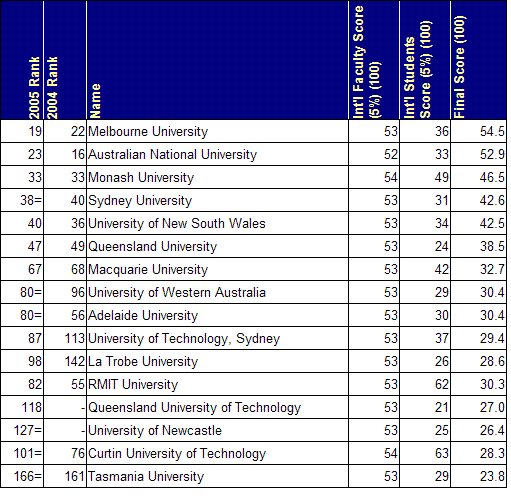 You would notice that with the exception of Monash and Curtin University, which scored 54, and Australia National University (ANU) which scored 52, all the rest of the 14 universities scored 53. Now, pardon me for being a bit sceptical - unless this is Australia's hidden university employment or recruitment policy, it is extremely unlikely that all Australian universities have equal proportions of local versus foreign academics.
Relative to all the other 200 ranked universities, Australian universities ranked between 25th to 41st in terms of "International Faculty Score".
2005 wasn't an exception as well. I went back to the 2004 data (see below) and found almost the exact same thing for the 15 listed universities. Barring ANU and Curtin, which scored 48 and 50 respectively, all the remainder 13 universities scored 49. Relative to all the other 200 ranked universities, Australian universities ranked between 13th to 24st in terms of "International Faculty Score" for 2004.
 Given that the "International Faculty Score" plays a significant 5% role in the rankings table, I would have expected the surveying company to have done a much better job with obtaining the data instead of (in all probabilities) extrapolating the data from 2-3 universities onto all the remaining universities in the country. After all, we have all experienced how the scores for international students and faculty wreaked havoc onto the rankings of our very own Universiti Malaya and Universiti Sains Malaysia.
For reasons which were stated here earlier by Kian Ming (and to be further elaborated some time down the road), I'm not in favour of the "international" factor constituting 10% of the overall scores. Nevertheless, I would really have expected QS Quacquarelli Symonds, the contracted survey company to have done much better.


No comments:
Post a Comment