


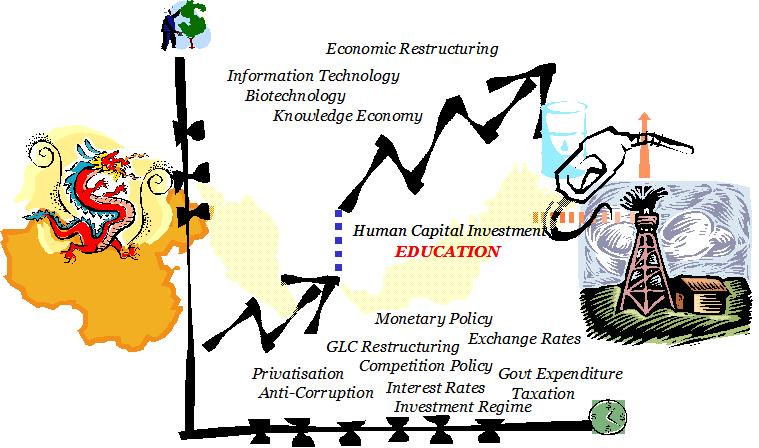
The diagram which I put up above probably summarises the entire gist of my presentation.
The Graph charts the growth path that Malaysian intends to pursue. For many years in the 1980s and early 1990s, Malaysia grew at a rapid rate of between 8-10% annually. Those would be the years that many businessmen will recall with fond memories. Unfortunately, by the time I started my own business, the boom years were a thing of the past.
Today, it appears that the structure of the Malaysian economy is only able to cater to growth in the region of 3-6%, with anything above 5%, we appear to be extremely thankful. Some of the tools that the government has to fine tune the 3-6% are highlighted in the bottom part of the chart. They include manipulating interest and exchange rates, the restructuring of government linked companies, tax and investment incentives etc.
On the left and right of the chart, you'll find the twin threats to the Malaysian economy as well as the largest factors keeping our growth rates capped at below 6%. First of all, we have China who have over the past decade emerged as the fastest growing economy in the world. As a result, China is sucking in all the foreign investments away from Southeast Asia - in manufacturing sectors from electronics to soft toys. Malaysia and Southeast Asia are no longer the "preferred" manufacturing base for foreign multinational companies.
On the right, you will have the sky-rocketing oil prices which may in the near term serve as an economic dampener to the global economy, which will in turn retard our growth. While the negative oil price impact on Malaysians will be negated somewhat from the fact that we are net exporters of oil, many other richer countries which dominate the global economy are not so lucky. As a result rising prices will result in a reduction of demand, particularly on electronic consumer goods. It's worth noting that manufacturing contributes to some 30% of the Malaysian economy, and the bulk of it is electrical manufacturing.
Hence the strategy of many nations like us today is really to diversify from industries in which China has an increasing (if not overwhelming) competitive advantage and focus on more intellectual property driven sectors. These "new" knowledge economy sectors as indicated in the top part of the chart, are meant to take Malaysia to the next level, hopefully a return to the glory days of 8-10% growth per annum, represented by the top arrow in the chart. You would have noted that the Malaysian government has "promoted" heavily in these "new economy" sectors such as information technology through the Multimedia Super Corridor and biotechnology through projects such as the BioValley and its corresponding tax and investment incentives.
However, try as hard as the government to promote these sectors, the rate of growth and development has been to date, a little disappointing. The underlying reason for the failure is extremely simple. While attempting to promote the "new economy", the regime is still pretty much focused on the "old economy" mechanisms. When Malaysia grew rapidly in the 1980s led by the manufacturing and industrial sectors, the key policies were to allocate land, provide pioneer and tax incentives, supply a pool of labour sufficiently literate to understanding assembly plant operations, and investors "flocked" to the country.
The same strategy appeared when Malaysia tried to move into the new economy. Promotions and incentives were given to geographically designated zones coupled with a liberalisation to import "knowledge workers" into the country.
What the government has failed to take into consideration really, and the real reason why these policies have not set the world alight, is simply "education". The knowledge economy is termed as such precisely because it relies almost entirely on top quality educated population. Practically everything else plays a supporting role. There is absolutely no short cut to the process. The "new economy", so to speak, is all about what's in the head, and not about competent workers operating machineries.
Only with the right amount, quality and level of education for the Malaysian population, can Malaysia hope to make the "jump" in growth rates from the unexciting 3-6% annually to anything above the 8% mark. Singapore is facing the same challenge as Malaysia in moving from a electronics-based manufacturing economy to a knowledge economy. However, their efforts, particularly in the biotechnology sector appears to be bearing fruits as the pharmaceutical based industries in Singapore helped pushed Singapore's growth rate last year to almost 7%, after "languishing" below 6% for a few years.
What's the difference in this case between Malaysia and Singapore? For me, it is in the difference between the educational institutions. This "education gap" is epitomised by the fact that the National University of Singapore (NUS) and the Nanyang Technological University (NTU) are both world-class institutions. For those interested in rankings, they are ranked 22nd and 48th respectively by the Times Higher Education Supplemnet (THES).
Probably more significantly, they are rated even higher for the new economy subjects, tecnology, science and biomedicine - which are critical inputs into the knowledge-based economy in the areas of information technology, high-end industrial design, biotechnology etc. Their rankings for these sectors are summarised below:
- Technology - NUS (9th) and NTU (26th)
- Science - NUS (34th) (There is no science faculty in NTU)
- Biomedicine - NUS (15th) (There is only a biological sciences school in NTU, no medicine faculty)
It appears quite obvious that Malaysia has decided to place greater importance of quantity over the need for quality. 3 universities serves the interest of the 4.4 million population in Singapore, while 38 similar institutions are serving the needs of Malaysia's 25.6 million. That means that Malaysia has more than double the relative ratios of universities. The ratio will only increase further as Malaysia has plans to add another public university in Kelantan soon and are upgrading more private colleges to "university college" status.
The fact that we have tens of thousand of unemployed graduates only serves to provide empirical evidence to the fact that we are over-producing degree graduates, the bulk of which do not meet the necessary standards to partake in the new economy. It was unsurprising that despite the shortage of labour to meet demand for computer engineers and programmers in the country, a large proportion of these unemployed graduates are actually from the computer science faculties of the local universities.
In the past, our manufacturing industries have been driven by "raw materials" which we have in abundance - land, commodities and affordable competent labour. The competitive advantage in these sectors have been eroded in the past years by "emerging" China and may one day, disappear altogether. However, despite the earnest in which the government is promoting the knowledge economy, we have not done enough to provide and supply the necessary "raw materials" for the new economy - a large enough and competent talent pool of graduates produced by top quality universities.
It is my humble opinion that, until the Malaysian government hardens its resolve to dramatically reform the education system from primary to tertiary in Malaysia to raise the quality output significantly, Malaysia's dreams of having the 'knowledge economy' to help boost growth in the country will not be achieved anywhere in the near future. I would call on the Government to spend the windfall income derived from the high and rising oil prices on improving the quality of education in Malaysia to leave an enduring legacy for the country. That is why, education is intrinsically and critically related to the future economy of Malaysia.


No comments:
Post a Comment