


The following table shows the top 20 Science universities in the world as per the THES survey. It is interesting to note that it appears that Oxbridge universities are actually rated better than the top universities in the United States for this year, and the previous year.
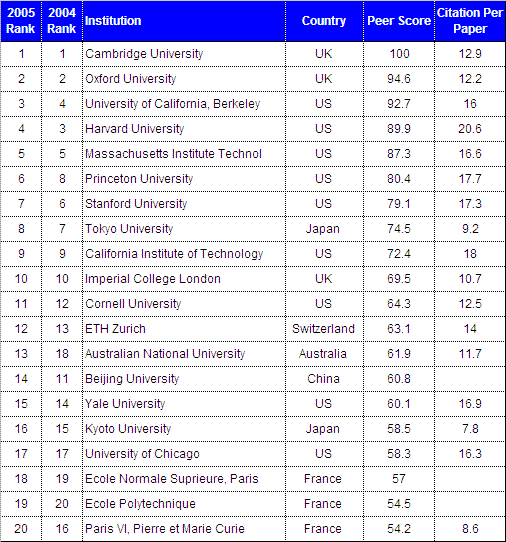
More interestingly, however, and it appears that the University itself have not yet discovered this, University Kebangsaan Malaysia (National University of Malaysia, UKM), has been included amongst the top 100 science universities in the world. UKM is ranked joint 91st, an improvement from being unranked in the previous year. UKM was also unranked in the world's top 200 universities ranking list for 2005 by THES. In this particular case, the ranking might just be a tad more credible than the achievement by Universiti Malaya and Universiti Sains Malaysia, which achieved their respective 89th and 111th world ranking last year, on the basis of a misguided "international faculty and students score". In this particular case, the science university ranking is provided purely on the basis of "peer review", although UKM had no "citations" to speak of. I would definitely be interested to find out more about the methodology used to derive the "peer review" score.
For those interested, the National University of Singapore (NUS) and Nanyang Technological University (NTU) are ranked 34th and 84th respectively. I've provided the table of the universities ranked 90th-100th below:

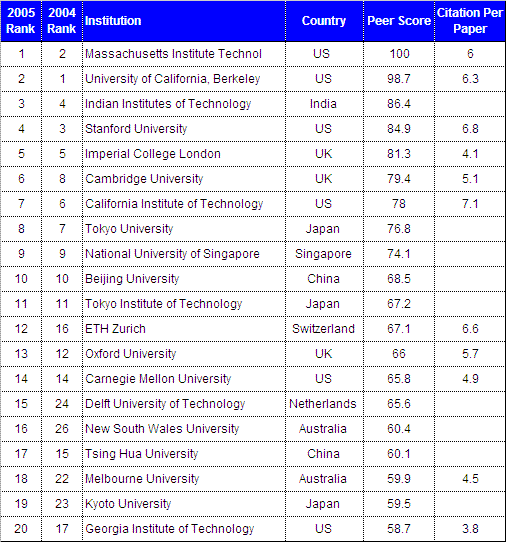
The top 100 technology universities of the world on the other hand, has a slightly different make up at the top. In this case, the universities of the United States are stronger and the top 20 consists of 7 universities from Asia as shown below. It appears that the Asian universities have been more adept in embracing technological advances to build competitive strengths than those in the Europe, which is represented by only 4 universities, of which 3 are from the United Kingdom (UK).
None of the Malaysian universities made it to the top 100 list for technology universities. On the other hand, Singapore fared particularly well here, with NUS and NTU ranked 9th and 26th respectively. More interestingly, Chulalongkorn University of Thailand made it to the 100th placement.
I hope that the above tables have been informative. I've received plenty of friendly criticisms on my blog post that I pay "way too much" attention on ranking tables for Universities. My personal opinion is that ranking tables are never going to be 100% accurate. However, I strongly believe that if the right methodology is used for the relevant compilation, the ranking tables will provide a good indication of where a university stands. For example, there probably isn't going to be much of a difference between enrolling into a university ranked 16th vs one that is ranked say, 24th. However, between say 16th and 67th, or say, between 48th and 97th, there are bound to be some significant differences.
In an age that we are bombarded with too much information, the bulk of which are ingeniously manipulated marketing information, there is a major need for some form of credible comparison tables to provide objective information to educators, students and parents. Go visit a website of a university ranked say, 104th and that of one ranked 12th, you will find that it is extremely likely that a student is unable to tell the difference in terms of quality between the two institutions. In fact, the lower ranked institution is more likely to "oversell" is quality and achievements in order to attract more students to the university, especially in the age where higher education is facing mass commercialisation.
Hence if anything, my approach to ranking tables will be to continually improve its accuracy and methodology, rather than to completely abandon or ignore such findings.


No comments:
Post a Comment